
In an era when artificial intelligence (AI) plays an important role in education and the labor market, preparing students for the future is a key responsibility of educational institutions. Developing only technical skills is no longer enough; students must also build the abilities that AI cannot replace.
Raquel Bernal, president of Universidad de Los Andes, told the World Economic Forum about three essential skills students need to thrive and succeed in an AI-powered world:

1. Digital Literacy
In a world where AI is part of everyday life, students must do more than operate technology. They must understand how AI works and recognize its limitations.
Digital literacy includes:
- Interpreting data and evaluating AI-generated results
- Using and communicating with algorithms
- Understanding cybersecurity
- Choosing AI tools that fit the context
Leading institutions, such as the University of Florida, have introduced AI Certificate programs for students in every field to broaden digital skills.
2. Digital Mindset
A digital mindset is a new way of thinking that embraces change, continuous learning, and initiative, using data and AI as important tools for growth.
Key elements of a digital mindset include:
- Being open to change
- Seeking learning opportunities
- Taking initiative and accepting ownership
- Leading efforts that drive innovation
Schools can foster a digital mindset through modular learning, constructive approaches to failure, and lifelong learning.
3. Human-Centric Skills
Although AI will play a larger role, distinctly human skills remain essential and cannot be replaced, including creativity, critical thinking, ethics, and communication.
Human-centric skills include:
- Creativity: Asking questions and looking for unconventional solutions
- Critical thinking: Analyzing information and making reasoned decisions
- Ethics: Using AI responsibly
- Communication: Explaining complex information clearly
Liberal arts and humanities education therefore continues to play an important role in developing well-rounded people for the digital age.
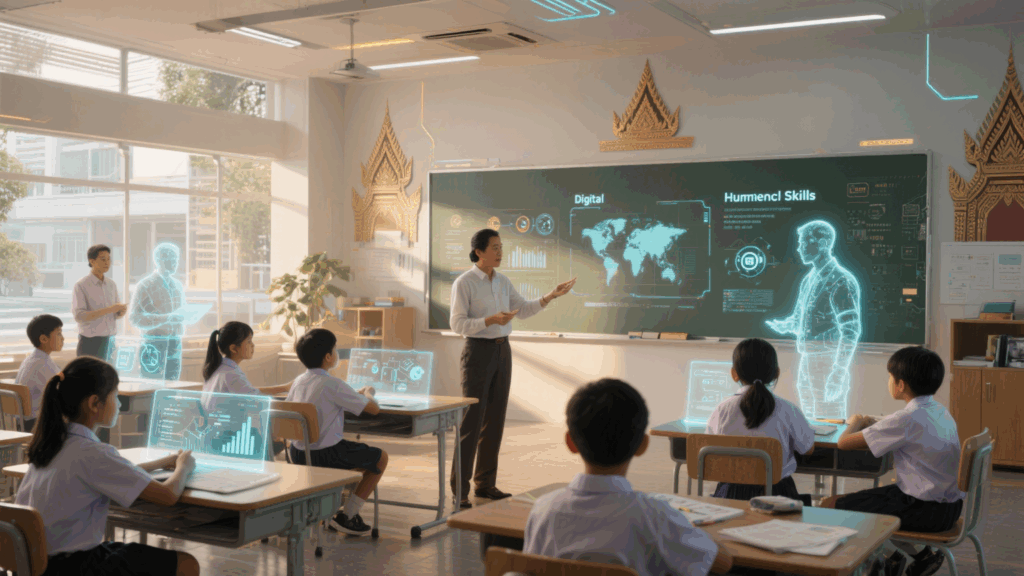
Recommendations for Thailand’s education system
To help Thai students compete globally, educational institutions should:
- Integrate these three skills into curricula at every level
- Build partnerships with industry
- Promote lifelong learning
- Develop curricula that respond to global change
Conclusion
Developing Digital Literacy, Digital Mindset, and Human-Centric Skills is the key to preparing students for a future in which AI is part of life and work.
Investing in education that combines technology with the humanities is the foundation for a country that can compete and create lasting value in the modern world.