
Over the past few years, large language models (LLMs) have become deeply embedded in society. At the same time, they face two major limitations: enormous energy consumption and dependence on expensive hardware resources such as GPUs from major manufacturers. These problems affect not only technological development but also the environment and the technological security of nations.
In September 2025, a research team from the Institute of Automation at the Chinese Academy of Sciences (CASIA) introduced SpikingBrain-1.0, a new language model designed directly around how the human brain works. It is one of the first concrete combinations of spiking neural networks (SNNs) and large language model development.
How it works: from Transformers to spiking neural networks
Traditional language models such as GPT and Llama use the Transformer architecture, which activates many neurons at the same time for each computation. This makes processing extremely energy-intensive.
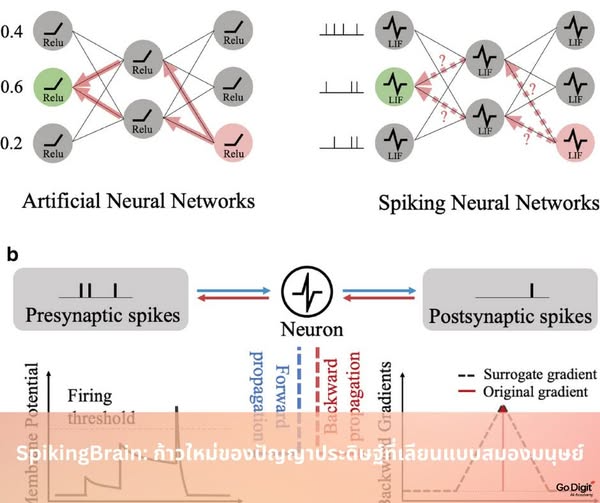
SpikingBrain takes a different approach. It uses Spiking Neural Networks that simulate the human brain. Neurons in this system “fire” only when they receive a stimulus—they are event-driven rather than active all the time. Most of the network therefore remains “quiet” until it is needed. This approach can significantly reduce energy use while retaining the ability to process large volumes of data.
SpikingBrain architecture
SpikingBrain has two main sizes:
- SpikingBrain-7B: a 7-billion-parameter linear model that uses linear attention and sliding-window attention to handle long sequences efficiently
- SpikingBrain-76B: a 76-billion-parameter hybrid model combining Mixture of Experts (MoE) with spiking mechanisms, creating several levels of sparsity to use less energy while retaining complex learning ability
The model also uses an adaptive-threshold spiking system that converts activations into event-based signals to control computing energy more precisely.
Stronger performance
Tests by the research team and reports from several sources indicate that SpikingBrain has notable performance:
- Speed: it can respond to text sequences of 4 million tokens more than 100 times faster than Transformer models, and generate the first token from a 1-million-token context up to 26.5 times faster
- Energy savings: it uses 97.7% less energy than FP16 processing and 85.2% less than INT8, with sparsity reaching 69.15%
- Learning from less data: it uses only 150 billion tokens (about 2% of the data used by comparable models) while achieving results close to well-known open-source models such as Mistral-7B and Llama3-8B
- CPU and edge operation: CPU tests show that SpikingBrain-7B runs 4–15 times faster than Llama3.2 on inputs of 64k–256k tokens
Hardware significance: China’s push for self-reliance
Another reason SpikingBrain is significant is that it was trained and run on a MetaX GPU cluster developed entirely by a Chinese company, without relying on NVIDIA GPUs whose exports are increasingly restricted. The technology therefore has national strategic significance: it reflects China’s effort to build an AI ecosystem it can control itself.
MetaX also designed a dedicated training framework, operator libraries, and parallel-processing mechanisms for its own hardware, allowing SpikingBrain training and inference to run efficiently.
Applications
SpikingBrain is designed for tasks that require handling extremely long text, such as:
- Searching legal documents and medical records
- High-performance scientific simulations
- DNA sequence analysis
Its low energy use and real-time capability could make it suitable for edge computing and portable devices, from drones and IoT devices to wearables that do not depend on large data centers.
Limitations and challenges
Although SpikingBrain’s results are impressive, several limitations require attention:
- Most research remains in arXiv preprint form and has not undergone external peer review
- Claims of performance several times higher may depend on specific testing conditions
- Real-world use may require specialized software, tools, and personnel for development and maintenance
- Competition in neuromorphic computing is intensifying worldwide, so it remains to be seen whether the Chinese team can retain its advantage
Future impact
SpikingBrain may signal that the AI industry is entering a new era: moving from a focus on model scaling laws toward designs that emphasize efficiency, sustainability, and brain-inspired computing.
If the technology is internationally validated and widely adopted, it could reduce the energy use of large data centers, strengthen hardware independence, and mark a step toward AI that more closely resembles the way the human brain works.
Conclusion
SpikingBrain-1.0 is not only an engineering achievement; it is also a bold experiment in applying principles of the human brain to AI. It points to the possibility of models that are faster, more energy-efficient, and less resource-intensive than conventional designs.
Questions and challenges still require further research, but SpikingBrain suggests that AI’s future may not lie in building ever-larger models. It may lie in understanding and emulating how nature produces intelligence through the human brain.