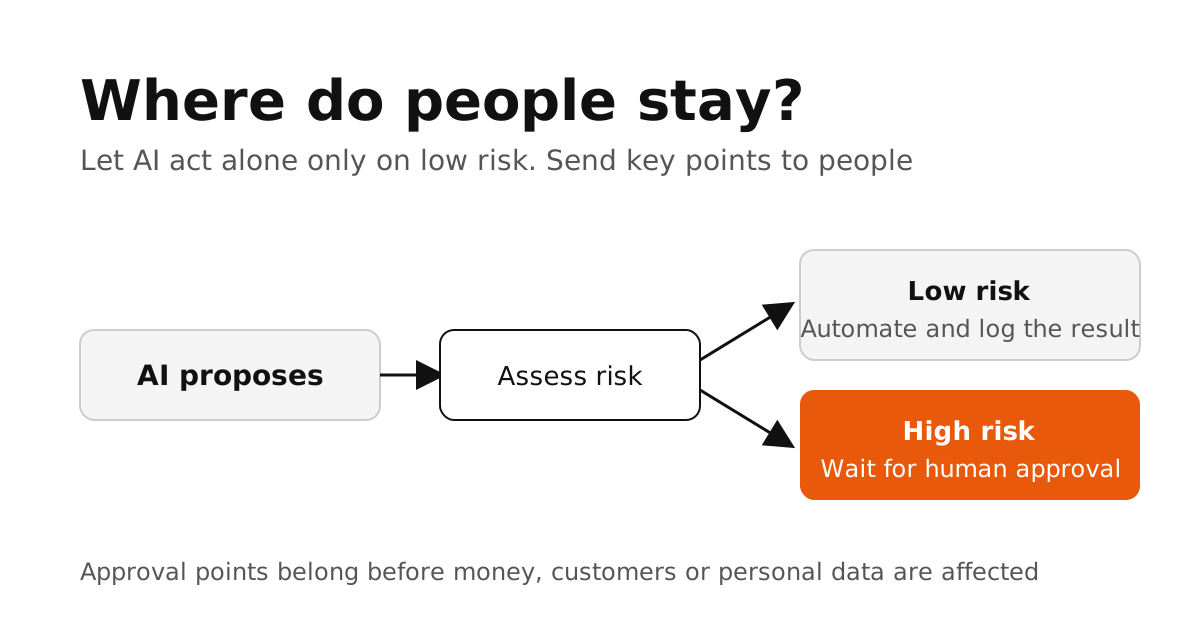
Once AI can act on its own, the real question is not whether it should act. It is where people should stay in the process. A workable answer is to let AI act alone on low-risk work, and send anything that affects money, customers or personal data to a person first.
Picture an AI that schedules internal document distribution every week. A mistake there is possible, but its impact is small and easy to undo. Compare that with an AI that approves a customer refund. Each error there carries a real cost.
What is an approval point?
An approval point is a step where the AI must pause and wait for a person to review and confirm before continuing. It keeps human judgement in charge of important decisions without requiring people to check every step.
Sort work by impact
✅ Low risk, such as sorting data, summarising internal documents or sending repeat reminders. Let AI handle these automatically and keep a record of the results.
✅ Medium risk, such as drafting a message to a customer. Let AI prepare it, then have a person read it before sending.
✅ High risk, such as approving payments, declining a customer request or changing personal data. A person should decide every time.
How to design approval points
- Map the impact of each step. Ask who is affected if it goes wrong and whether the change can be reversed.
- Name one owner per approval point. Shared responsibility with no clear owner usually means no one takes it.
- Show the reasoning behind each recommendation, so the approver can see what the AI suggests and why.
- Log every approval and rejection so decisions can be reviewed later.
- Review the thresholds periodically. Work that once needed approval may move to automatic handling when there is evidence it is safe.
See how NextBrain sets approval points in the request path →
Things to watch
⚠️ Approving out of habit. If people confirm every request without reading it, the approval point becomes a formality.
⚠️ Too many approval points. If every step waits for a person, the system becomes too slow for anyone to use.
⚠️ No clear accountability. When someone approves without knowing exactly what they approved, responsibility disappears on both sides.
Frequently asked questions
Continue reading: What is an AI agent, and where should an organisation start · AI governance: the rules Thai organisations should prepare for
💬 In your organisation, which work could AI handle alone, and which should a person decide? Share your view in the comments.