
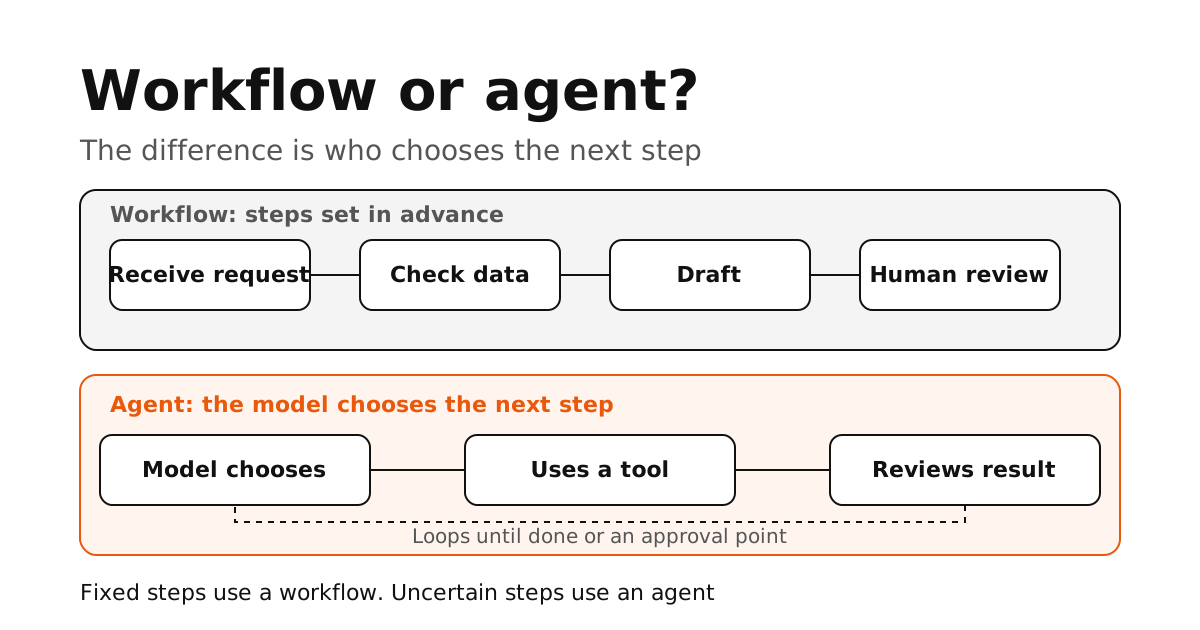
"Workflow" and "AI agent" are often used interchangeably, but they differ on one question: who chooses the next step. If people define the steps in advance, it is a workflow. If the model decides as it goes, it is an agent.
Think of a factory conveyor belt compared with a craftsperson who receives a brief. The belt repeats the same steps well every time, but the craftsperson looks at the work in front of them and decides what to do next.
A workflow is a set of steps defined in advance
A workflow is a designed sequence of work. Every step is known beforehand, so the same input follows the same path.
✅ Predictable. Every request passes through the same steps, which makes it easy to check.
✅ Controllable. You know where the AI is called and what it is asked to do.
✅ Lower cost and risk. The system does not have to decide the route itself.
An agent is a system where the model chooses the next step
An agent takes a goal, then chooses tools and steps along the way. It reviews the result, decides what to do next, and keeps going until the task is finished or reaches a point where a person must step in.
✅ Flexible. It copes better with inputs that do not look the same each time.
✅ Handles unknown paths. For example, research where the search terms change based on what is found.
⚠️ Harder to check. The route may differ from run to run, so every step needs to be recorded.
How to choose
Answer three questions before you decide.
- Are the steps known in advance? If they are, and they stay the same, use a workflow.
- Are there many exceptions? If the work often needs judgement when something unexpected appears, an agent may suit it better.
- Can mistakes be reversed? If they are hard to undo, limit the agent's freedom and add approval points.
Start with a workflow, then add an agent where needed
Most work does not need to be an agent from start to finish. A practical approach looks like this:
- Map the existing steps of the task before deciding anything.
- Make the fixed parts a workflow, such as receiving data, checking its format and saving the result.
- Let an agent choose only where judgement is needed, such as which source to search.
- Put an approval point before any step that affects money or customers, as described in the article on approval points.
Read more about what an AI agent is and where to start →
Things to watch
⚠️ Using an agent for everything. Tasks with clear steps become slower and harder to check for no good reason.
⚠️ Giving too much freedom. An agent with access to important systems and no checkpoints may do things nobody intended.
⚠️ Not recording the route. When something goes wrong, you cannot tell which decision the agent made, or when.
Frequently asked questions
Continue reading: Context engineering: what your AI sees decides the answer · When AI acts on its own, where should people stay in the process?
💬 Is the work in your organisation better suited to a workflow or an agent? Share your view in the comments.